nextgen solar sails
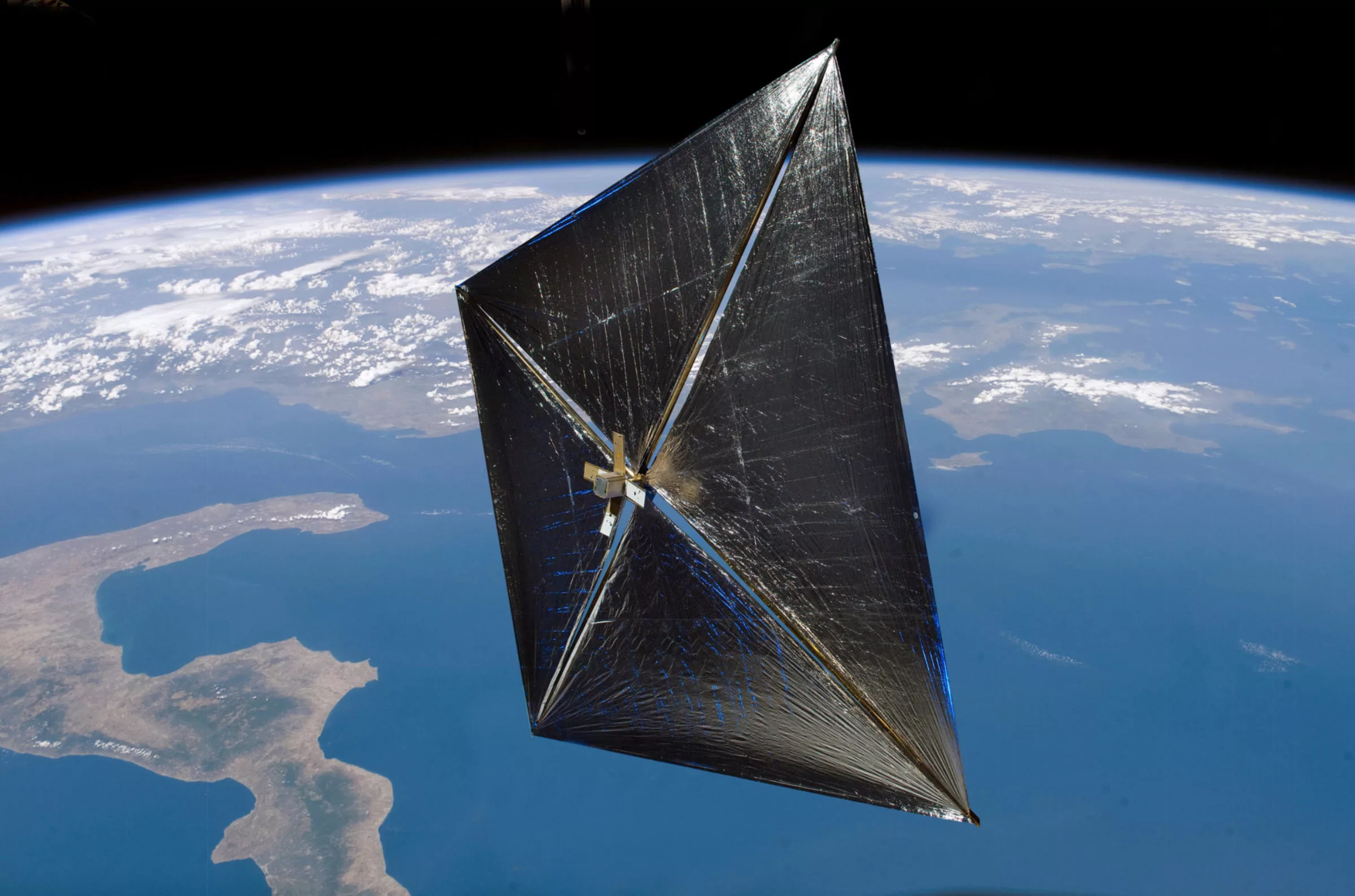
Let’s craft Solar Sails (cheaply & at home)
Rockets are fast but solar sails are faster! Also, we can’t really (shouldn’t) play with rockets (nor nuclear ones) in our kitchen…
So, how about projecting Humanity through the stars using some fishing line, a pack of chips and some ducktape?
Seriously, solar sailing is extremely promising. Chemical rockets max out at ~500 Isp while solar sails could achieve a tenth of the speed of light. They take a long time to accelerate but do so without requiring fuel. They are made of a large reflective surface & a payload: steering, comms and what have you. In other words solar sails are mostly defined by their mass-to-area ratio.
I propose you invent a new sail that beats the mark of <10g/m² (or >100m²/kg) for less than 30€, with your hands and some ✨SCIENCE✨.
Bill of Materials
Space blankets ~3€
Emergency thermal blankets aka. Mylar (aka. BoPET) sport an amazing ~98% reflectivity. Meaning most of the energy hitting it transforms to momentum and not heat. They only deform at >200°C plus they don’t outgas.
Fishing line ~5€
Nylon thread can be twisted to act as Nylon Linear Material Actuators aka NLMAs, pulling with great force compared to its weight when heated to ~120°C. Per this 2016 paper: New twist on artificial muscles.
See also this cute Instructables: Fabricating Fishing Line Artificial Muscle at Home.
Note however that Nylon should be replaced with Polyester (Dacron) thread or Kevlar/Aramid which contain much less water, before circumnavigating the planet.
Ducktape ~20€
Space-grade 3M™ Adhesive Transfer Tape 966 is specifically tested to meet NASA & ESA standard ASTM E595: <1.0% mass outgassed. It handles 120°C with ease and will not produce fumes that kill you.
DIY
Temperatures in Low Earth Orbit range from –170°C to 123°C. There, sunlit Nylon muscles tense.
Set your kitchen oven to thermostat 4 (gas mark ½) to reproduce this 120°C cooking orbit.
Now it is up to you to find a way to combine the above materials (and/or more) into a tightly-packed structure that unfolds once in LEO and takes a flat enough shape to reflect Sun rays.
In short:
- Overall weight must be minimized and then so should initial volume (deployed within a Space launch vehicule)
- Structure must not outgas: materials should not sublimate nor exert gas (attitude would change, lifespan would shorten)
- LEO insolation temperatures should be utilized as deployment energy
This challenge is proposed to University (or High School) students to devise a way to fit the largest & lighest (& mightiest) Solar Sail they can in the cheapest Cubesat possible, aiming for a total mass below 10g/m², all hardware included.
See also
- Electric sails à la flying spiders
- Laser sails
- Alpha CubeSat University project
- Using inflatable booms
- Shaping sail surface
- ToughSF’s blog: Riding Sunbeams with Solar Sails
Some of my own explorations
Tumbleweed-like structure + insolated Nylon muscles to open up parabolic surface
Light but solid “articulations” keep the shape in extension, once Nylon muscles extend it

Tensegrity
BEST (Berkeley Emergent Space Tensegrities) Robotics lab.
Knitting configurations
Cool videos.
The Ripstop pattern.
Circular techniques.

Auxetic dome
Nylon muscles pull on the many centroids such that the plane expends into a dome that then stays as such
- (2021) Bistable Auxetic Surface Structures
- Auxetics & Metamaterials (+Grasshopper Tutorial)
- Check out github.com/UH-AIM/bistable-auxetic-surface-structures by The Architected Intelligent Matter (AIM) lab.
- Bistable Auxetic Surface Structures (Full Talk for SIGGRAPH 2021)
- Bistable Auxetic Surface Structures (Supplementary Video)